GigFuse
Connecting local talent with live events.

Overview
GigFuse is a one-stop platform for artists to showcase their skills, discover work opportunities, engage with event coordinators and talent seekers, and broaden their reach across diverse artistic domains. It streamlines the artist's path so they can navigate and succeed in their creative endeavours.
Problem statement
- Event organizers and venues in B2B markets struggle to find local artists for gigs and events.
- Locating suitable local talent is time-consuming and frustrating.
- Difficulty identifying artists hampers event execution, leading to setbacks and missed opportunities.
- Stakeholders are dissatisfied with inefficient artist discovery.
- No streamlined platform exists for engaging local artists and improving event management in the B2B sector.
Solution
A central hub for event planners, venue owners and artists, built around six pillars:
Search & Discovery
Find local artists by location, genre, availability and budget.
Artist Profiles
Showcase skills, experience, portfolio and availability for gigs.
Hiring & Communication
Communicate and book gigs easily, cutting administrative tasks.
Ratings & Reviews
Both parties review each other, building trust and credibility.
Notifications & Alerts
Alerts for new gigs, inquiries, booking confirmations and upcoming events.
Community Building
A community that encourages collaboration and networking.
Design process
Discover
- Design strategy
- User research
- Competitive analysis
Define
- Persona
- Empathy map
- Problem statement
Ideate
- User journey map
- User flow
- Card sorting
- Information architecture
Design
- Lo-fi wireframes
- Hi-fi wireframes
- Visual design
- Prototype
Test
- Usability testing
Discover
Executive intent
Revolutionize event coordination through a comprehensive, user-friendly app connecting organizers, venues and artists. Simplify finding and booking local artists for gigs and events while building a robust community of creatives.
Target audience
Art enthusiasts seeking opportunities to showcase their skills, gain exposure and earn money. Ages 18 to 55.
Competitive analysis
I reviewed existing apps offering similar services to see how they address user needs and where there is room to grow. All three are available on Android, iOS and web.
| Stage 32 | Paytm Insider | Crevado | |
|---|---|---|---|
| Portfolio showcase | Yes | No | Yes |
| Community engagement | Yes | Yes | Yes |
| Job opportunities | Yes | Yes | No |
| Learning resources | Yes | Yes | No |
| Certification courses | Yes | No | No |
| Events & industry updates | Yes | Yes | Yes |
| Event organizers | Yes | Yes | No |
Stage 32
Strength: specialized entertainment networking, education and collaboration. Gap: overcrowding, quality control and limited mobile functionality.
Paytm Insider
Strength: a huge user base. Gap: fraud risk, and weak discovery for emerging artists.
Crevado
Strength: easy, customizable portfolio creation. Gap: fewer advanced features and no organizer or job layer.
User research
I designed a questionnaire and ran a series of interviews with people engaged in various art forms, to understand the market and the challenges and pain points users face.
Qualitative research
Phone interviews with 10 individuals passionate about music, dance, photography and painting, to understand the challenges of turning a hobby into a full-time career. Over 78 responses in total.
Quantitative research
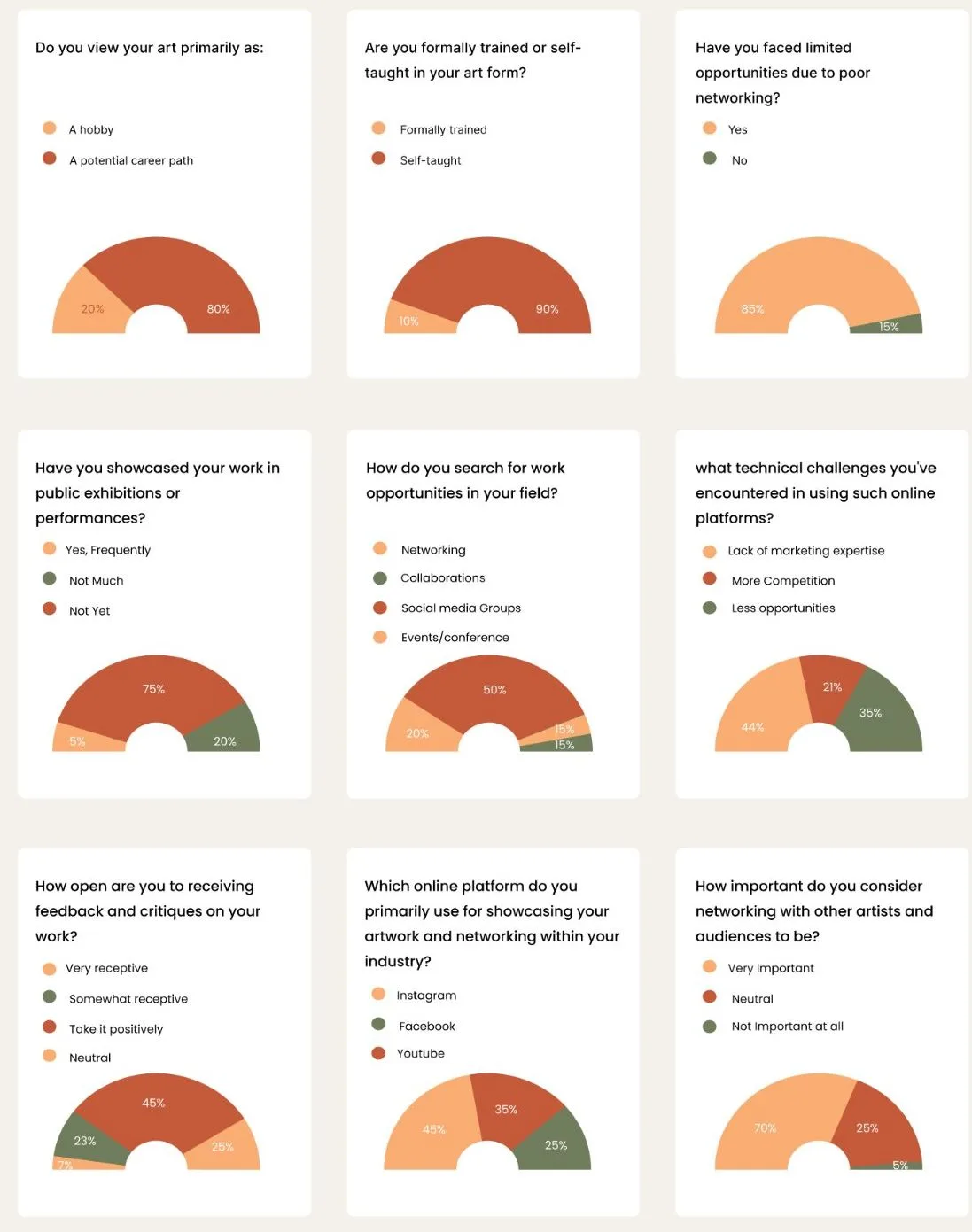
An online survey on Google Forms to find patterns in user preferences. Responses from 56 individuals helped define the problem accurately.
What the survey told us
see their art as a potential career path, not just a hobby.
are self-taught rather than formally trained.
have faced limited opportunities due to poor networking.
say networking with other artists and audiences is very important.
primarily use Instagram to showcase their work and network.
name lack of marketing expertise as their top technical challenge on online platforms.
Interview questions
- What drives your passion within your chosen art form?
- Do you see your art as more of a hobby or a potential career path?
- What do you consider your most valuable skills as an artist?
- Have you received formal training, or are you self-taught?
- What support or resources are missing for people trying to turn hobbies into full-time jobs?
- Do you prioritize improving your skills or networking, and why?
- Which online platform do you use to showcase your work and grow connections?
- What technical challenges have you faced on such platforms?
- How do you search for work opportunities in your field?
- How receptive are you to feedback and critiques?
Define
Meet Vani
26, an architect based in Pune and a theater enthusiast. In her free time she sharpens her drama skills and collaborates with local theater groups to find new opportunities in Pune's drama scene.
Goals
- Enhance and experiment with new forms of theater.
- Expand her network for work and stay updated on local events.
- Explore projects and collaborations.
- Earn enough money and get known for her style.
Pain points
- Balancing a job and a passion for theater is tough with limited time.
- Her job limits how much she can invest in attending events.
- Hard to connect deeply with the local theater scene.
- Standing out in a diverse talent pool is frustrating.
Motivations
Her passion for drama, the chance to discover new communities, collaborating at diverse local events, and a platform to perform and show her talent. Her empathy map surfaced the same tension: deep passion, balanced against the stress of a day job.
Ideate
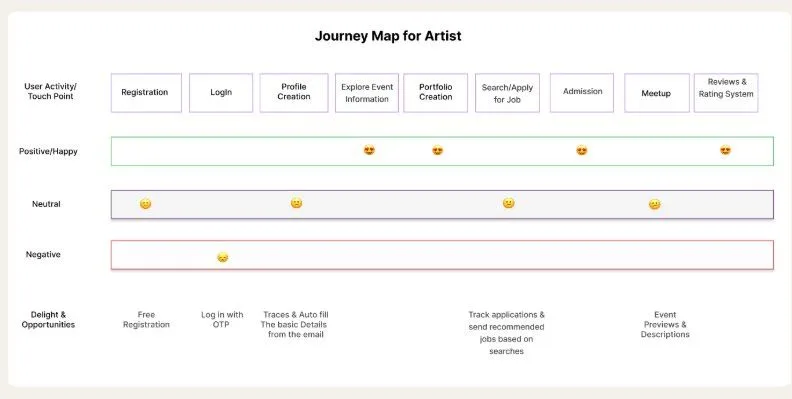
User journey maps
Journeys for both artists (registration to reviews and ratings) and event organizers (registration to posting a job, finding an artist and meetups) highlighted the delight points: free registration, OTP login, auto-filled profile details, recommended jobs and event previews.
User flow
Card sorting
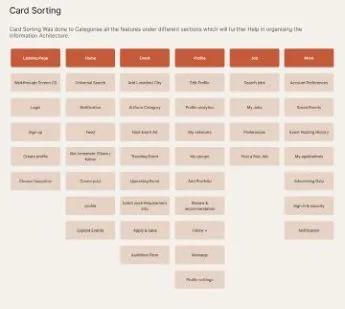
Card sorting categorized all features under sections (Landing page, Home, Event, Profile, Job, More), which then shaped the information architecture.
Information architecture
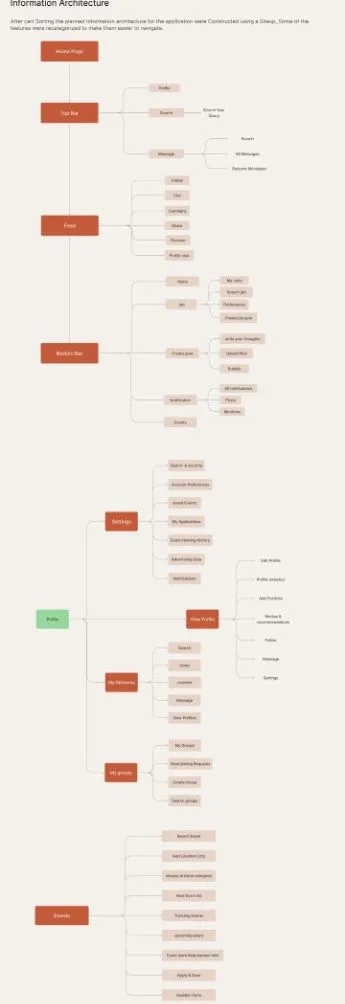
After card sorting, some features were recategorized to make them easier to navigate.
Design
Low-fidelity wireframes
Used to plan layout and functionality around user needs and journeys, and to establish the basic structure before moving into Figma.

High-fidelity wireframes
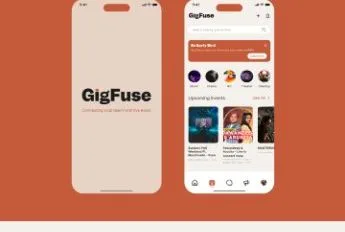
Refined into polished screens in Figma, with the terracotta brand colour and a card-led home that surfaces upcoming events.
Test
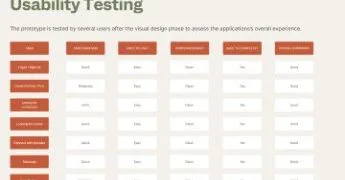
After the visual design phase, the prototype was tested with several users to assess the overall experience, covering tasks such as sign-up, profile creation, finding events and messaging.